Youtube

Youtube
GYAN & VIGYAN

Wednesday, November 8, 2023

RCCB – Residual Current Circuit Breaker


Table of Content

1. Principle behind RCCB.
2. Benefits Of RCCB.
3. Sensitivity Of RCCB.
4. Limitations Of RCCB.
5. Classification Of RCCB.

While electricity has become an indispensable component of our lives, the fact is, it comes with its own hazards to human life and property. Electrocution and fire being the two major risks associated with electricity, one cannot afford to be negligent when it comes to insulating equipment.
A Residual Current Circuit Breaker (RCCB) is an important safety measure when it comes to protection of electrical circuits. It is a current sensing device, which can automatically measure and disconnect the circuit whenever a fault occurs in the connected circuit or the current exceeds the rated sensitivity.

Aimed at protecting an individual from the risk of electric shocks as well as electrocution and fires, RCCB is particularly helpful in instances of sudden earth fault. The presence of RCCB ensures that in such cases, the circuit will trip immediately and the person is thus protected from an electric shock.

Principle behind RCCB

RCCB works on the principle of Kirchhoff’s law, which states that the incoming current must be equal to the outgoing current in a circuit. RCCB thus compares the difference in current values between live and neutral wires. Ideally, the current flowing to the circuit from the live wire should be the same as that flowing through the neutral wire. In case of a fault, the current from the neutral wire is reduced, the differential between the two known as Residual Current. On spotting a Residual Current, the RCCB is triggered to trip off the circuit.

A test circuit included with the Residual Current device ensures that the reliability of RCCB is tested. When the test button is pushed, the current starts to flow through the test circuit. As it creates an imbalance on the neutral coil of the device, the RCCB trips and supply is disconnected thereby checking RCCB’s reliability.

Benefits of RCCB

  • Provides protection against earth fault as well as any leakage current
  • Automatically disconnects the circuit when the rated sensitivity is exceeded
  • Offers possibility of dual termination both for cable and busbar connections
  • Offers protection against voltage fluctuation as it includes a filtering device that guards against transient voltage levels.


Sensitivity of RCCB

A human being is able to sustain an electric shock to the extent of 30 mA. While upto 10 mA may just evoke a prickling sensation, 10 mA onwards may lead to muscular contraction, further leading to a respiratory paralysis at around 30mA. RCCBs are therefore designed to look for small changes in residual current. In cases where protection from fire is sought, RCCBs are also used to track higher changes in residual current of up to 300mA.

Limitations of RCCB

While RCCB has many advantages, it has some limitations as well:

  • RCCB does not guarantee to operate if none standard waveforms are generated by loads. It’s mainly because RCCB is designed to operate on normal supply waveforms.
  • There might be some unwanted tripping of RCCB. It’s mainly because whenever there are sudden changes in electrical load, there can be small current flow to earth especially in the old appliances.
  • RCCB does not protect from current overload. It has been designed to protect only when the live current and neutral current are different. However, a current overload cannot be detected.
  • RCCB does not protect against line-neutral shocks. It’s mainly because current in them is balanced. The current gets balanced as both terminals are held together.
  • RCCB does not protect from the overheating that strike if conductors are not properly screwed into terminals.


Classification of RCCB

RCCB are of two types; the 2 Pole RCCB and 4 Pole RCCB.

2 Pole RCCB:

This is used in case of a single-phase supply connection that has only a live and a neutral wire.

4 Pole RCCB:

This is used in case of a three-phase supply connection.

Rating from 10 Amp ….100 Amp
Sensitivity 30,100,300 m Amp

RCCB is therefore extremely important in providing real time protection for circuits. In industries and high voltage commercial set ups especially, its importance cannot be undermined as there is always risk of shocks and accidental deaths on account of it. At C&S Electric, we offer Wintrip RCCB, a state-of-the-art product fit for industrial, residential and commercial application. C&S RCCBs conforms to IEC 61008 – 1 and is used for both control and isolation of electrical circuits. Being a respected global brand for power management products for over 50 years, with C&S Electric you can rest assured knowing that you are in safe hands.

MCCB: Uses, Applications & Advantages


Table of Content

1. Specifications of MCCBs
2. Components of Molded Case Circuit Breakers
3. There are several advantages of the MCCB
4. Thermal Overload
5. Short-circuit Condition
6. Ground Fault condition
7. Wrong Selection of MCCB

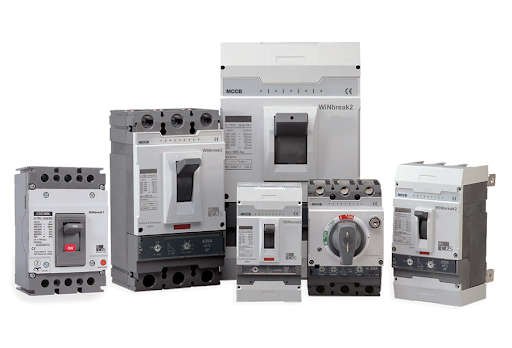
MCCB is the device which is manufactured as an integral inner supporting and enclosed housing of insulating material. It is required for making, carrying and breaking currents between separate contacts under normal circuit condition and abnormal circuit condition such as those of overload condition and short circuit condition. MCCBs provide protection to low-voltage distribution system.

Quenching the arc in air inside the moulded case, the MCCBs interrupt current with range from few amperes to several kilo-amperes. MCCBs are useful for protecting the system against faults like Overload & Short Circuit, with the help of release which may be Thermal Magnetic or Microprocessor Type. MCCB satisfies the requirement of isolation as it provides complete isolation to the circuit.. Compact Size, Lower Downtime, Reduction in inventory & Availability of various accessories makes it a distinctive product.

Specifications of MCCBs:

  1. Ue – Rated Operational Voltage
  2. Ui – Rated Insulation Voltage
  3. Uimp – Impulse withstand voltage
  4. In – Nominal Rated Current
  5. Ics – Service Short Circuit Breaking Capacity
  6. Icu – Ultimate Short Circuit Breaking Capacity


Components of Molded Case Circuit Breakers

Operating Mechanism:

The Operating Mechanism handles the opening and shutting of the contacts. The speed that the contacts open or close is free of how quick the handle is moved. The breaker can’t be kept from stumbling by holding the handle in the on position. The handling will be in a halfway position when the contacts are stumbled.

Arc Extinguisher:

An arc is made at whatever point an electrical switch interferes with a present stream. The Arc Extinguisher’s activity is to limit and separation that circular segment, subsequently stifling it. At the point when an intrusion happens and the contacts partitioned, the present course through the ionized area of the contacts actuates an attractive field around the bend and the circular segment douser.

Trip Unit:

The Trip Unit is the cerebrum of the electrical switch. The capacity of the unit is to trip the working system in case of an abnormal condition. Electronic trip units are presently accessible and they can give considerably more refined insurance and observe.

The MCCB Working in itself is an incredible invention. The MCCB is a choice to a wire since it needn’t bother with a substitute once an over-burden is taken note. Dissimilar to a wire, this electrical switch can be just reset after a misstep and offers improved administrator security and straightforwardness without procuring working expense. For the most part, these circuits have warm current for overcurrent and the attractive component for impeding to work quicker.

 There are several advantages of the MCCB:  

  • MCCBs are Compact in the measure. Hence it spares a significant space inboard plan.
  • MCCBs has to limit downtime. Dissimilar to in a breaker-based framework, there’s no looking for a substitution intertwine. It very well may be Reset and Switched On again instantly in the wake of finding the blame that caused the stumbling amid activity.
  • MCCBs can clear a few blame previously it is expected for substitution.
  • MCCBs are “Upkeep Free” and its repeating costs are less.
  • At the point when MCCBs are utilized, at that point, there is no probability of single staging because of blame in just a single stage.
  • Some multi-reason adornments can be fitted with the MCCB.

MCCB with the combination of one or the two different trip elements will protect the circuit against situations such as: 

Thermal Overload:

In the conditions of overload, there is a temperature between the insulation and conductor. If the insulation remains unchecked, its life will reduce and the maintenance would be higher. It is important to catch the approach of MCCB for the better flow of circuit and lifelong approach of the product.

Short-circuit Condition:

It is the conditiondue to an intentional or unintentional low impedence path creation between phase wires or a neutral & phase wires, this situation leads to an excessively high current flowing through the circuit & voltage becomes negligible

Ground Fault condition:

It is also the type of the short circuit which is linked with the ground phase. This is the common fault which takes place in the low voltage.

The MCCB protects the huge amount of mess and protects the system while enhancing the capability. The MCCB is highly durable and the life of these gadgets are longer than usual gadgets. It is suitable for the higher energy impact. The gadget must be installed by the professional because it is not that easy to be installed and once it is done, you are free to form the obstacles that you might face regarding electricity, short-circuits, and the low-voltage.

Now days MCCBs are available with 2 kinds of release, one is with thermal-magnetic &other is microprocessor release.

Thermal-magnetic uses the principle of bimetal and electro-magnetic coil. Thermal protection is required for O/L & electromagnetic or solenoid is used for S/C. but since electromagnet is a peak sensing device thus a slight transient peak can cause nuisance tripping of MCCB. This CB gives following protections

  • Thermal /Overload Protection- Through Bimetal
  • Electromagnetic /Short Circuit Protection- Through Electromagnet
  • Under Voltage Protection- Through U/V Release

Microprocessor or electronic release sense true R.M.S value of current. It is simulated and calculated from peak values, which are detectable by microprocessor. The microprocessor based release may offer below protections which can be add on:

  • Earth Fault
  • Neutral protection
  • Instantaneous Over-ride
  • Earth Leakage
  • Current Unbalance
  • Overvoltage


Wrong Selection of MCCB:

For few special applications, manufacturers recommend to use MCCBs dedicated to that application. For Ex. For motor back up protection there is a requirement for overload protection of motor, it is required to match the overload settings of MCCB with that of motor. This solution assures no damage to the motor in case of motor overloading. However life expectancy of contactor as per the circuit design is considered better than that of MCCB. Hence this combination will give much lesser life, thus it can’t be suggested. Also we can’t have the single phasing protection by using MCCB. Hence, in this case ‘Type 2’ coordination charts shall be referred so as to make an appropriate selection.

FluidFlow

  FluidFlow  Explore the latest FluidFlow articles to learn more about our sector leading innovations and relevant industry tr Fan Laws and ...