Youtube

Youtube
GYAN & VIGYAN

Wednesday, November 8, 2023

Everything You Need to Know About Circuit Breakers: Introduction, Applications, and Types


Table of Content

1. What is CIRCUIT BREAKER
2. NEED OF CIRCUIT BREAKER
3. TYPES OF CIRCUIT BREAKERS
4. CIRCUIT BREAKERS AT A GLANCE
5. MEDIUM VOLTAGE & HIGH VOLTAGE CIRCUIT BREAKERS


What is CIRCUIT BREAKER

The circuit breaker is a switching device which also offers protection by tripping & cutting off the supply to load in case of fault. Primarily the circuit breakers are used for switching of different kinds of load in Industries, Buildings, Commercial Complexes, and Hotels, etc.

NEED OF CIRCUIT BREAKER

Many kind of abnormal conditions are there which exist in our electrical system that have the potential to damage the circuit & its components. These conditions are defined as ‘FAULTS’.Further, fault is categorized as mentioned below:

  • Overload
  • Short Circuit
  • Earth

In order to keep our electrical components & system safe, it is mandatory to protect our system against the above faults. This leads to the need of circuit breaker.


TYPES OF CIRCUIT BREAKERS

Circuit breakers mainly are categorized on the basis of application as per voltage:

1) Low Voltage Circuit Breaker

2)  Medium Voltage Circuit Breakers

3) SF6/VACUUM Circuit Breakers

4) High Voltage Circuit Breakers

  • VCB
  • SF6
  • OCB
  • ABCB


CIRCUIT BREAKERS AT A GLANCE:

LOW VOLTAGE CIRCUIT BREAKERS

Circuit Breakers operating for the voltage up to 1KV are LV or Low Voltage Circuit Breakers which are as follows:

  • MOLDED CASE CIRCUIT BREAKER (MCCB)

MCCB or Molded Case Circuit Breaker is a kind of circuit breaker which is enclosed in the moulding or housing of a moulded material & that is the reason it is known as Molded Case Circuit Breaker. It is generally used for the current ratings upto 1600A & fault level upto 150KA. It offers protection against overload & short circuits through bimetal & solenoid, these days Microprocessor based MCCBs are being very popular due to the quick functioning of their electronic type release.

  • MINIATURE CIRCUIT BREAKER (MCB)

MCB or Miniature Circuit Breaker is a circuit breaker which is used for protection where current ratings are lower. It can be used upto 125A circuits & like MCCBs it also offers protection against overload & short circuit through bimetal & solenoid. These days Class 3 MCBs are very popular due to their ability of tripping quickly & also minimum loss of let through energy.

  •  AIR CIRCUIT BREAKER (ACB)

AIR CIRCUIT BREAKER or ACB as the name suggests it’s the circuit breaker where the medium of arc quenching is air. ACB is used for the high current applications, or we can say that ACB can offer protection against overload & short circuit upto 6300A. Tripping in ACB is achieved through release. The release is known as the mind of ACB as it only suggests the ACB to trip in case of fault.

  • MOTOR PROTECTION CIRCUIT BREAKER (MPCB)

MPCBs are used specially for motor protections. MPCB as a standalone device offers protection against Overload, Short Circuit & Single Phasing, thus is used specifically for motor applications.

  • RESIDUAL CURRENT CIRCUIT BREAKER (RCCB)

RCCBs as the name suggests offer protection against Earth Leakage. It is used in homes, offices & industries according to the current sensitivity required as per application. In case of current leakage it senses the same & trips thus, saving the human & circuit from shock & adverse effects of current leakage.


MEDIUM VOLTAGE & HIGH VOLTAGE CIRCUIT BREAKERS

Voltage level from 1KV-69KV is categorized under medium & 69KV-230KV is categorized as High Voltage. Circuit Breakers operating in these voltage ranges are known as Medium & High Voltage CBs respectively.

  • VACUUM CIRCUIT BREAKER  (VCB)

Vacuum Circuit Breaker or VCB is used for Medium Voltage applications. In VCB the contacts operation & arc quenching takes place inside bottles where Vacuum is present.

  • SF6 CIRCUIT BREAKER

SF6 circuit breakers are also used mainly in medium voltage applications. In this breaker SF6 gas is used for arc quenching due to its ability of quenching the arc very efficiently. SF6 Breakers being highly efficient in arc quenching are still not preferred much as SF6 being a poisonous gas, is dangerous to environment & humans.

  • OIL CIRCUIT BREAKER (OCB)

Oil Circuit Breakers were also used on high voltages & Oil was used as the arc quenching medium.

Difference Between Fuse & Circuit Breaker


Table of Content

1. What is Fuse?
2. As per IEC 60269, the fuse can be identified as mentioned below:
3. What is Circuit Breaker?
4. Key differences between Fuse & Circuit Breaker

In an electrical system ‘Fault’ is the condition which arise due to the malfunctioning of some component or wrong electrical practice. The fault may lead to a very dangerous situations such as explosion & fire if not cleared timely, not only this the amount of time for which fault persists in the system it continuously deteriorates the system health causing high energy losses resulting in increased thermal stress upon the system. From the above paragraph, it is clear that the faults are hazardous to the system & requires to be cleared at the soonest thus, there is a need of such device which not only is capable of clearing the fault but also have a lower opening time in order to save the let-through energy & minimize the thermal stress. Fuse & Circuit Breaker are the devices that fulfill the above criteria of the protection device i.e. capability of clearing the fault & also have a lower opening time hence saves the let through energy as well.

What is Fuse?

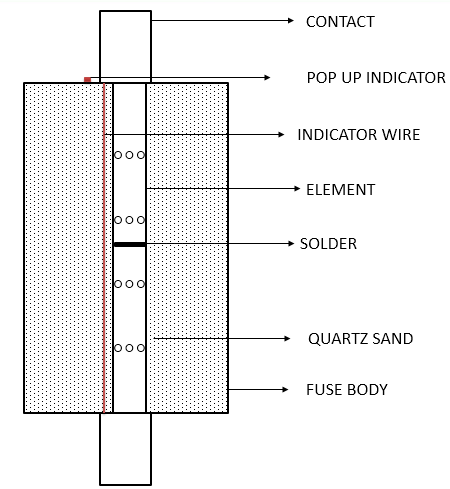
Complying with IEC 60269, fuse is a device that blows in case of a fault & can offer protection up to 80KA even beyond that. Whenever there is a fault in the system the fuse blows off & protects the system by cutting off the supply. A fuse is generally made of a ceramic body, having an element, The body is filled with quartz sand as shown in the fig:

HIGH RUPTURING CAPACITY (HRC) FUSE

Whenever there is an overload in the system, the solder as shown, gets into a chemical reaction resulting in cutting off the supply. In case of short circuit the element gets torn due to the application of high electrodynamic force on the same because of high current such as short circuit. The blown fuse can be easily identified by the pop up indicator which pops up whenever the fuse interrupts. The function of quartz sand is to successfully quench the arc & absorb the pressure thus, not letting the fuse to explode. The fuse is the staunchest combatant of the system as it is the quickest interrupting device available in the entire electrical system. The fuse blown within 2-5ms hence saving the maximum amount of let-through energy.

As per IEC 60269, the fuse can be identified as mentioned below:

  • The first letter is ‘a’ if the fuse is for short-circuit protection only; an associated device must provide overload protection.
  • The first letter is ‘g’ if the fuse is intended to operate even with currents as low as those that cause it to blow in one hour, ex. Overload. These are considered general-purpose fuses for the protection of wires.
  • The second letter indicates the type of equipment or system to be protected:
  • G – General purpose protection of wires and cables
  • M – Motors
  • PV – Solar photovoltaic arrays as per 60269-6
  • R, S – Rectifiers or semiconductors as per 60269-5
  • Tr – Transformers

Fuse although, is the most dependable & trusted protection device but can be used only one time, in no case the fuse can be repaired, after it blows off it only needs to be replaced.


What is Circuit Breaker?

circuit breaker is a switching device which also offer protection against short circuit. Unlike fuse the circuit breaker do not blows off, but trips whenever there is a fault. The circuit breaker complies with IEC 60947-2 & can offer protection up to 150KA even beyond that, also a circuit breaker can offer a no of protections such as against:

  • Overload
  • Short Circuit
  • Under Voltage
  • Neutral
  • Earth Fault

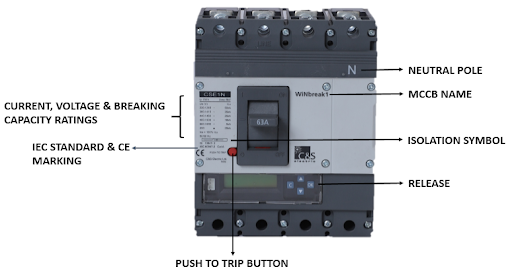
A typical labelled diagram for the circuit breaker is as shown below:

MOULDED CASE CIRCUIT BREAKER

A circuit breaker is not required to be replaced after tripping once, instead it must complete its total no of operations as declared by the manufacturer. The tripping time for the circuit breaker may vary w.r.t its type, for ex. the trip time for MCCB is less than 10ms & the opening time for ACB shall be less than 30ms. Not only this, MCCB also has a dedicated position for tripping, whenever the MCCB trips, its actuator lever comes in between i.e. neither in ‘ON’ nor in ‘OFF’ position.

According to the medium of arc quenching circuit breaker can be differentiated as below

SNOMEDIUM OF ARC QUENCHINGCIRCUIT BREAKER
1AIRACB, MCCB
2VACUUMVacuum Circuit Breaker
3GASSF6 Circuit Breaker
4OILOil Circuit Breaker

For tripping the circuit, a circuit breaker requires a release which senses the fault & gives a tripping command to the circuit breaker.

As per the method of tripping, the circuit breaker can be below types

SNOMETHOD OF TRIPPINGCIRCUIT BREAKER
1BIMETAL (for Overload) & Armature (for Short Circuit)Thermal Magnetic Type
2ELECTRONICMicroprocessor Type

Today the circuit breaker not only offers protection, but also has other features such as Annunciation, Current, Voltage & Power Metering, Communication capability, Energy Measurement etc. which differentiate it from the fuse, also the use of circuit breaker leads to lower maintenance time, lower inventory & finally cost saving. Despite the above advantages of the circuit breaker over fuse, the fuse still has a higher hand on the circuit breaker & that is because of its tripping time which is minimum, which is why in few applications fuse is used even at the upstream of circuit breakers.


Key differences between Fuse & Circuit Breaker

SNOPARAMETERSFUSECIRCUIT BREAKER
1MAINTENANCEFuse can only be used 1 time, it is a non- reusable deviceCircuit Breaker can offer total no of operations as declared by manufacturer.
2TRIP TIME2-5ms, quickest operating deviceVary as per the device, ex: for ACB it can be 30ms & for MCCB can be less than 10ms
3UTILIZATION CATEGORYIf first letter is ‘g’ means both protection (O/L + S/C), If first letter is ‘a’ only S/C will be there.If category A it means no Icw shall be there, If category B, Icw shall be there
4METHOD OF TRIPPING‘SOLDER’ for Overload, ‘ELEMENT’ for Short CircuitAvailable as ‘MICRPROCEESOR’ type & ‘THERMAL MAGNETIC’ type

FluidFlow

  FluidFlow  Explore the latest FluidFlow articles to learn more about our sector leading innovations and relevant industry tr Fan Laws and ...